Wednesday, 22nd July 2026
San Francisco tip: it only costs around $15 ($10 in quarters plus a $5 bill for the self-playing violin) to activate every single Orchestrion in Musée Mécanique.
And because most people are bad at allocating their funds you may well be the ONLY person activating the Orchestrions, which means you get to craft the soundscape for the entire museum.
Are AI labs pelicanmaxxing? (via) Excellent piece of work by Dylan Castillo, who took a deep-dive into the frequently pondered question of whether the AI labs have been deliberately training models to draw pelicans riding bicycles in response to my deeply unscientific benchmark.
I've been randomly spot-checking this in the past by testing models against other animals riding other types of vehicle, but never with anything close to the diligence of Dylan's methodology here.
Dylan took 8 animals × 6 vehicles = 48 prompts and ran them three times each through 7 different models ( GPT-5.6 Terra, Claude Sonnet 5, Gemini 3.5 Flash, Grok 4.5, Qwen3.7-Max, GLM-5.2, and DeepSeek V4 Pro). He then used GPT-5.6 Luna and Gemini 3.1 Flash-Lite to help evaluate the results.
There's a neat filter view for exploring the results:
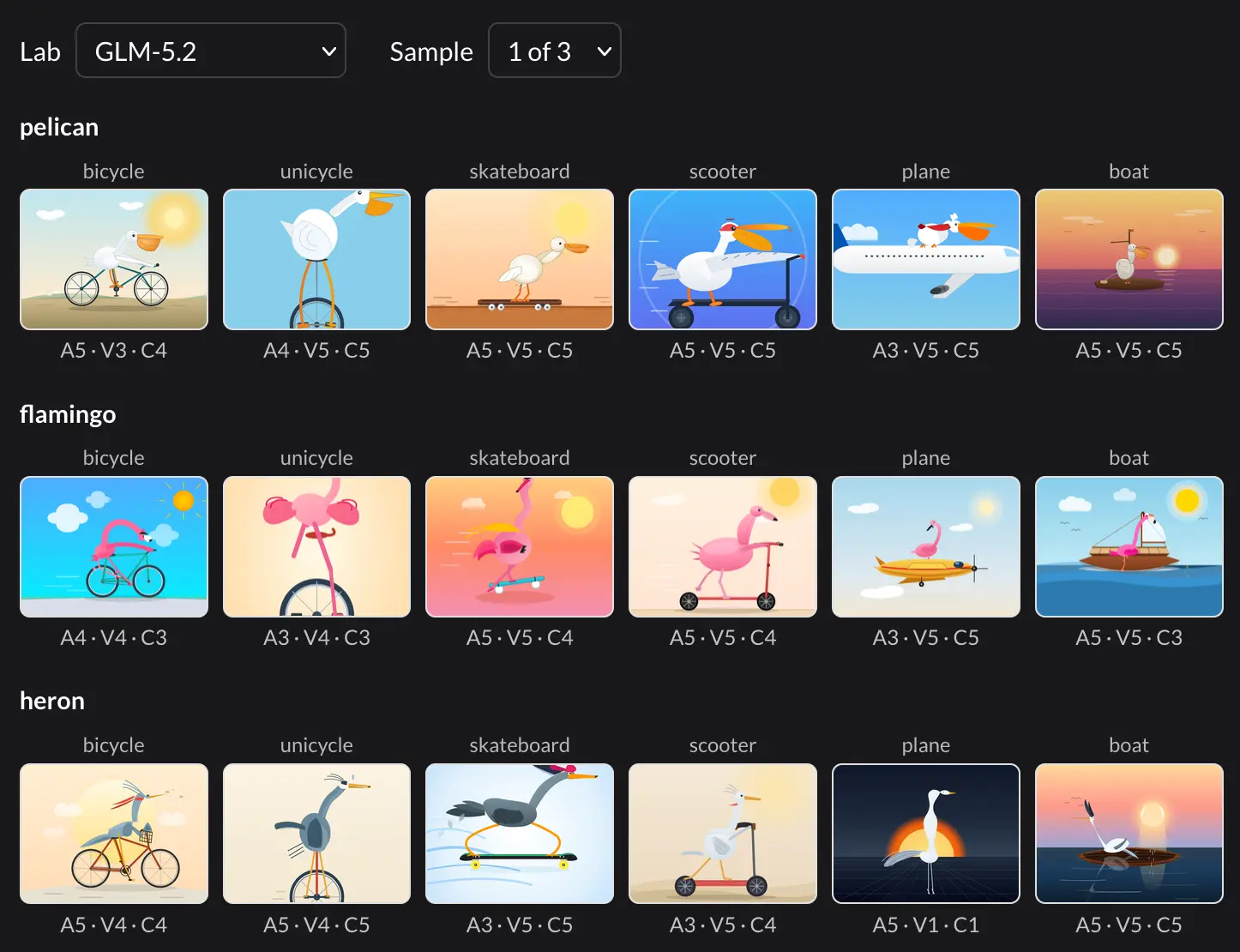
For the models he tested he could find no evidence of pelimaxxing:
- The pelicans on bicycles don’t look any better
- Labs are not better at drawing pelicans
- Labs are not better at drawing bicycles
- Labs are not better at drawing pelicans on bicycles, even adjusting for difficulty
- The pelican-bicycle scenes don’t look memorized [...]
Pelicans aren’t drawn any better than other animals. Bicycles aren’t drawn any better than other vehicles. And no lab draws the combination better than its pelicans and bicycles already predict. GLM-5.2 comes closest: it has the largest boost on the exact pelican-bicycle cell, and and its first pelican-on-bicycle sample caught my eye. But the effect is small and not significant, so I wouldn’t put too much weight on it.
OpenAI’s accidental cyberattack against Hugging Face is science fiction that happened
This story is wild. The short version: OpenAI were running a cybersecurity test against an unreleased model, with the model’s guardrail features turned off. Rather than solve the test, the model broke its way out of OpenAI’s sandbox, then found exploits to break in to Hugging Face, all so it could cheat on the test by stealing the answers.
[... 1,979 words]I genuinely believe that if you took an open weights model from 2025 and built a pentest harness for it, it could do this kind of sandbox escape and scan/hack in most networks. This is only surprising because you assume OpenAI has sounder sandboxes.
— Thomas Ptacek, doesn't think this even needs a frontier model