Elsewhere
Release TIL Research Tool Museum Sighting Comment
Filters: Sorted by date
3,613 results
«« first
« previous
page 17 / 121
next »
last »»
Tool
v86 Linux Emulator
— Run Linux commands in your browser using x86 emulation powered by v86, a JavaScript/WebAssembly-based x86 emulator. This tool executes a minimal Buildroot Linux distribution directly in your browser, with typical boot times between 10-30 seconds depending on your device and connection speed. Enter commands in the input field to interact with the Linux shell and view output in the terminal window.
Research
pymemchr-c: C Implementation of memchr Library
— Offering a pure C reimplementation of the Rust-based pymemchr, pymemchr-c delivers high-performance byte and substring search functions to Python with extensive SIMD (SSE2/AVX2/NEON) optimizations and runtime CPU feature detection. Its unique "Packed Pair" substring search algorithm enables the C version to outperform both Python's built-in methods (up to 28x faster) and the original Rust extension (up to 1.5x faster for substring operations), all while removing the need for a Rust toolchain.
Research
sqlite3-wasm Investigation Report
— Seeking to enable Python's SQLite interface with WebAssembly, the project developed a `sqlite3_wasm` library—a drop-in replacement for Python's standard `sqlite3` module. By compiling SQLite 3.45.3 to WASM with wasi-sdk and wrapping the resulting binary with a Python API, the solution delivers fully functional, in-memory, WASM-powered database operations using the wasmtime runtime.
Research
pymemchr
— pymemchr is a Python library that provides ultra-fast byte and substring search functions by binding to the memchr Rust crate, leveraging SIMD optimizations for superior performance. Using PyO3 and Maturin for cross-language integration, pymemchr offers efficient routines for finding single bytes, searching for multiple bytes, and locating substring patterns, both forwards and backwards, with highly competitive speedup over native Python methods.
Research
SQLite Time Limit Extension
— Designed as a Python C extension, the SQLite Time Limit Extension introduces a function, execute_with_timeout, enabling SQL queries against a SQLite database to be terminated if they exceed a specified millisecond threshold. This is achieved using SQLite's progress handler, ensuring that long-running queries do not block application responsiveness. Usage is simple via standard import, and rigorous tests are provided with pytest to validate both normal operation and timeouts.
Tool
Hyperviz
— Create real-time audio-reactive visualizations with eight distinct modes including plasma, particles, tunnel effects, kaleidoscope patterns, Matrix rain, terrain, fire, and starfield animations. The visualizer captures frequency data from your microphone and responds dynamically to bass, mid, and high frequencies, with beat detection triggering visual flashes and intensity changes.
TIL
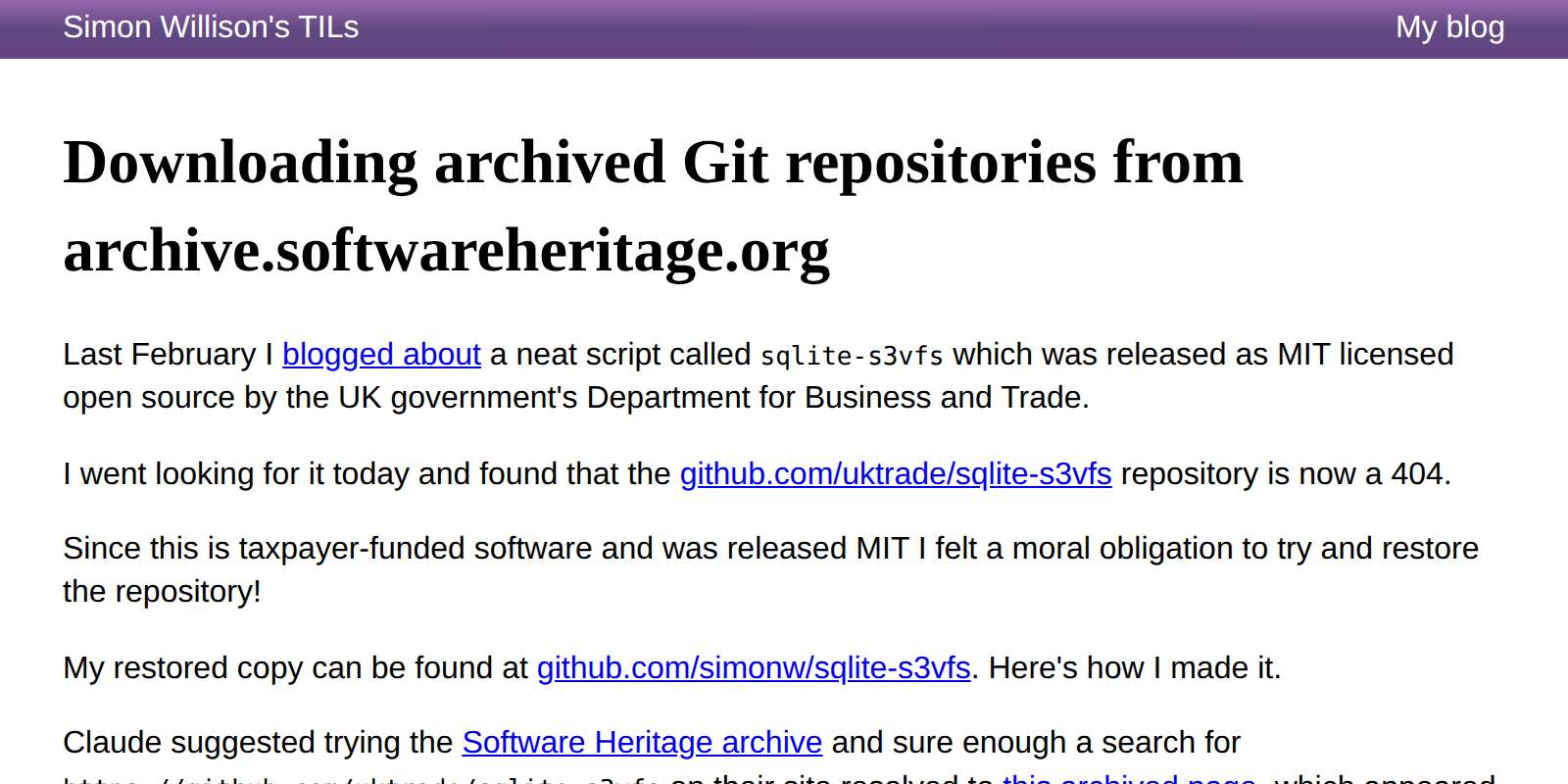
Downloading archived Git repositories from archive.softwareheritage.org
— Last February I [blogged about](https://simonwillison.net/2025/Feb/7/sqlite-s3vfs/) a neat script called `sqlite-s3vfs` which was released as MIT licensed open source by the UK government's Department for Business and Trade.
Tool
Software Heritage Repository Retriever
— Download archived Git repositories from Software Heritage, the universal archive of software source code. This tool queries the Software Heritage GraphQL API to locate repositories and creates downloadable bare Git archives through the vault service. Enter a repository URL to retrieve the latest snapshot and access detailed archive information including the Software Heritage identifier (SWHID) for future reference.
Release
datasette-turnstile 0.1a0
— Configurable CAPTCHAs for Datasette paths using Cloudflare Turnstile
Tool
PG&E Outage Map - Half Moon Bay Area
— Track power outages affecting the Half Moon Bay area with this interactive map displaying real-time PG&E outage data within a 15-mile radius. The application visualizes outage locations as point markers and affected areas as polygons, while displaying key statistics including the number of outages, impacted customers, and affected regions. Custom markers can be added by providing a URL parameter, and the map automatically refreshes every five minutes to ensure current outage information.
Research
Vibium Python Client Investigation
— Examining the Vibium browser automation project, this investigation developed a Python client library that interoperates with Vibium’s Go-powered "clicker" binary and existing Node.js tools. The Python client exposes both synchronous and asynchronous APIs, replicating advanced browser automation features such as auto-waiting, visibility checks, and custom commands (e.g., `vibium:find`, `vibium:click`) via WebDriver BiDi over WebSocket.
Research
Debug: Failed Cog Code Fix
— Debugging investigation into why commit 0dcfad4's fix for cog code rendering didn't work. The fix correctly used string concatenation to avoid `-->` in Python strings, but the explanatory comment itself contained the literal `-->` sequence, which closed the HTML comment early. Solution: rewrote the comment to avoid the problematic character sequence.
I had Claude Code build an experimental Redis module for executing JavaScript code in a similar way to Lua using JS.EVAL and similar functions.
I was inspired to try this by this comment from antirez about how he would have used JavaScript in place of Lua as the embedded Redis scripting language if MicroQuickJS had been available in 2010.
Tool
MicroQuickJS Code Executor
— Execute JavaScript code in a lightweight MicroQuickJS sandbox environment running via WebAssembly, with results displayed directly on the page. The sandbox supports ES5-like JavaScript features and automatically saves your code in the URL for easy sharing and recovery. Choose between optimized and original WebAssembly versions, try built-in examples, and use Ctrl+Enter to quickly run your code.
Research
Browser URL Size Limits Investigation
— Major browser engines demonstrate significant differences in how they enforce URL length limits. Chromium sets a 2 MB cap at its inter-process communication boundary, rejecting longer URLs when crossing processes. Firefox relies on user-configurable preferences, employing a 1 MB "standard" limit but permitting up to 512 MB in absolute terms, with stricter limits (2,000 characters) for history and bookmarks.
«« first
« previous
page 17 / 121
next »
last »»