Monday, 27th April 2026
Speech translation in Google Meet is now rolling out to mobile devices. I just encountered this feature via a "try this out now" prompt in a Google Meet meeting. It kind-of worked!
This is Google's implementation of the ultimate sci-fi translation app, where two people can talk to each other in two separate languages and Meet translates from one to the other and - with a short delay - repeats the text in your preferred language, with a rough imitation of the original speaker's voice.
It can only handle English, Spanish, French, German, Portuguese, and Italian at the moment. It's also still very alpha - I ran it successfully between two laptops running web browsers, but then when I tried between an iPhone and an iPad it didn't seem to work.
Tracking the history of the now-deceased OpenAI Microsoft AGI clause
For many years, Microsoft and OpenAI’s relationship has included a weird clause saying that, should AGI be achieved, Microsoft’s commercial IP rights to OpenAI’s technology would be null and void. That clause appeared to end today. I decided to try and track its expression over time on openai.com.
[... 691 words]microsoft/VibeVoice. VibeVoice is Microsoft's Whisper-style audio model for speech-to-text, MIT licensed and with speaker diarization built into the model.
Microsoft released it on January 21st, 2026 but I hadn't tried it until today. Here's a one-liner to run it on a Mac with uv, mlx-audio (by Prince Canuma) and the 5.71GB mlx-community/VibeVoice-ASR-4bit MLX conversion of the 17.3GB VibeVoice-ASR model, in this case against a downloaded copy of my recent podcast appearance with Lenny Rachitsky:
uv run --with mlx-audio mlx_audio.stt.generate \
  --model mlx-community/VibeVoice-ASR-4bit \
  --audio lenny.mp3 --output-path lenny \
  --format json --verbose --max-tokens 32768
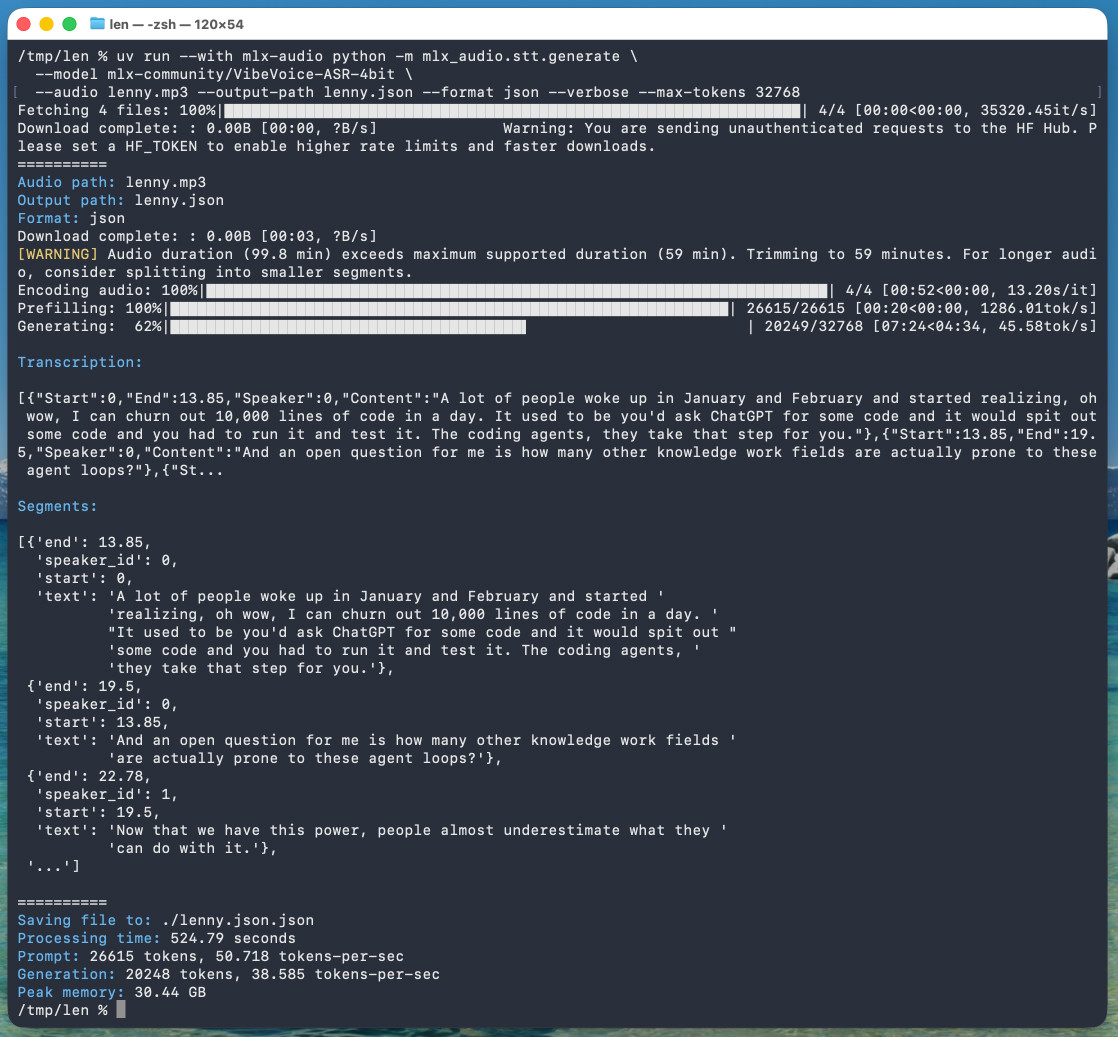
The tool reported back:
Processing time: 524.79 seconds
Prompt: 26615 tokens, 50.718 tokens-per-sec
Generation: 20248 tokens, 38.585 tokens-per-sec
Peak memory: 30.44 GB
So that's 8 minutes 45 seconds for an hour of audio (running on a 128GB M5 Max MacBook Pro).
I've tested it against .wav and .mp3 files and they both worked fine.
If you omit --max-tokens it defaults to 8192, which is enough for about 25 minutes of audio. I discovered that through trial-and-error and quadrupled it to guarantee I'd get the full hour.
That command reported using 30.44GB of RAM at peak, but in Activity Monitor I observed 61.5GB of usage during the prefill stage and around 18GB during the generating phase.
Here's the resulting JSON. The key structure looks like this:
{
  "text": "And an open question for me is how many other knowledge work fields are actually prone to these agent loops?",
  "start": 13.85,
  "end": 19.5,
  "duration": 5.65,
  "speaker_id": 0
},
{
  "text": "Now that we have this power, people almost underestimate what they can do with it.",
  "start": 19.5,
  "end": 22.78,
  "duration": 3.280000000000001,
  "speaker_id": 1
},
{
  "text": "Today, probably 95% of the code that I produce, I didn't type it myself. I write so much of my code on my phone. It's wild.",
  "start": 22.78,
  "end": 30.0,
  "duration": 7.219999999999999,
  "speaker_id": 0
}
Since that's an array of objects we can open it in Datasette Lite, making it easier to browse.
Amusingly that Datasette Lite view shows three speakers - it identified Lenny and me for the conversation, and then a separate Lenny for the voice he used for the additional intro and the sponsor reads!
VibeVoice can only handle up to an hour of audio, so running the above command transcribed just the first hour of the podcast. To transcribe more than that you'd need to split the audio, ideally with a minute or so of overlap so you can avoid errors from partially transcribed words at the split point. You'd also need to then line up the identified speaker IDs across the multiple segments.