Friday, 3rd April 2026
The Axios supply chain attack used individually targeted social engineering
The Axios team have published a full postmortem on the supply chain attack which resulted in a malware dependency going out in a release the other day, and it involved a sophisticated social engineering campaign targeting one of their maintainers directly. Here’s Jason Saayman’a description of how that worked:
[... 357 words]In trying to build my own version of Claude Artifacts I got curious about options for applying CSP headers to content in sandboxed iframes without using a separate domain to host the files. Turns out you can inject <meta http-equiv="Content-Security-Policy"...> tags at the top of the iframe content and they'll be obeyed even if subsequent untrusted JavaScript tries to manipulate them.
Months ago, we were getting what we called 'AI slop,' AI-generated security reports that were obviously wrong or low quality. It was kind of funny. It didn't really worry us.
Something happened a month ago, and the world switched. Now we have real reports. All open source projects have real reports that are made with AI, but they're good, and they're real.
— Greg Kroah-Hartman, Linux kernel maintainer (bio), in conversation with Steven J. Vaughan-Nichols
The challenge with AI in open source security has transitioned from an AI slop tsunami into more of a ... plain security report tsunami. Less slop but lots of reports. Many of them really good.
I'm spending hours per day on this now. It's intense.
— Daniel Stenberg, lead developer of cURL
On the kernel security list we've seen a huge bump of reports. We were between 2 and 3 per week maybe two years ago, then reached probably 10 a week over the last year with the only difference being only AI slop, and now since the beginning of the year we're around 5-10 per day depending on the days (fridays and tuesdays seem the worst). Now most of these reports are correct, to the point that we had to bring in more maintainers to help us.
And we're now seeing on a daily basis something that never happened before: duplicate reports, or the same bug found by two different people using (possibly slightly) different tools.
— Willy Tarreau, Lead Software Developer. HAPROXY
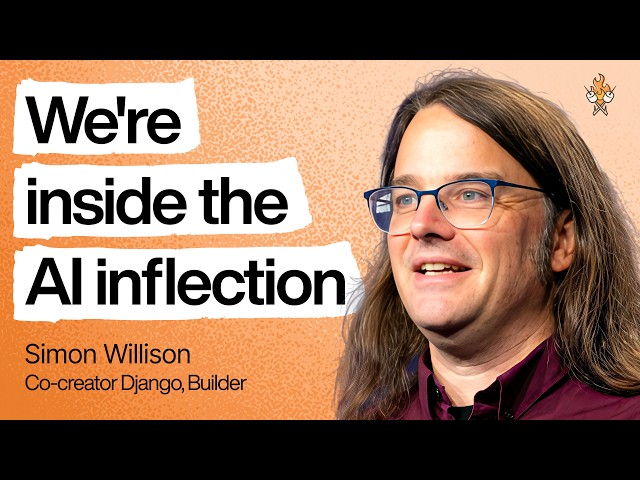
A fun thing about recording a podcast with a professional like Lenny Rachitsky is that his team know how to slice the resulting video up into TikTok-sized short form vertical videos. Here's one he shared on Twitter today which ended up attracting over 1.1m views!
That was 48 seconds. Our full conversation lasted 1 hour 40 minutes.
Vulnerability Research Is Cooked. Thomas Ptacek's take on the sudden and enormous impact the latest frontier models are having on the field of vulnerability research.
Within the next few months, coding agents will drastically alter both the practice and the economics of exploit development. Frontier model improvement won’t be a slow burn, but rather a step function. Substantial amounts of high-impact vulnerability research (maybe even most of it) will happen simply by pointing an agent at a source tree and typing “find me zero days”.
Why are agents so good at this? A combination of baked-in knowledge, pattern matching ability and brute force:
You can't design a better problem for an LLM agent than exploitation research.
Before you feed it a single token of context, a frontier LLM already encodes supernatural amounts of correlation across vast bodies of source code. Is the Linux KVM hypervisor connected to the
hrtimersubsystem,workqueue, orperf_event? The model knows.Also baked into those model weights: the complete library of documented "bug classes" on which all exploit development builds: stale pointers, integer mishandling, type confusion, allocator grooming, and all the known ways of promoting a wild write to a controlled 64-bit read/write in Firefox.
Vulnerabilities are found by pattern-matching bug classes and constraint-solving for reachability and exploitability. Precisely the implicit search problems that LLMs are most gifted at solving. Exploit outcomes are straightforwardly testable success/failure trials. An agent never gets bored and will search forever if you tell it to.
The article was partly inspired by this episode of the Security Cryptography Whatever podcast, where David Adrian, Deirdre Connolly, and Thomas interviewed Anthropic's Nicholas Carlini for 1 hour 16 minutes.
I just started a new tag here for ai-security-research - it's up to 11 posts already.