Tuesday, 10th November 2026
I realized I didn't know where Yonkers was, so I looked it up on Google Maps and then, to help embed its location and shape in my head (and to try out Claude Fable 5.2's 3D modeling and animation skills), I prompted Fable 5.2 Medium to:
Make a three js animation where yonkers stands up as a big mech (cool stand up motion) and átomos around manhattan and queens and Brooklyn, use openstreetmap mapping data
It correctly deduced that "átomos" was a mobile keyboard typo for "stomps":
Claude Fable 5.2 responds closely to what the prompt says about who owns the code it works on. In Anthropic’s testing on small coding tasks, when a prompt said nothing about ownership or presented the code base as someone else’s, the model tended to add to the existing structure, even when that repeated existing code. [...]
If you want the model to improve the structure as it works, say that the code is its own:
This codebase is yours: what it's for and how it's built are your call, and you'll keep building on it.In Anthropic’s testing on small coding tasks, the model merged repeated code in about half of the tries with this sentence, and in under a tenth of the tries without it.
— Prompting Claude Fable 5.2, Anthropic documentation
Introducing Our Smallest, Most Efficient Model: Muse Ember. Meta AI just launched their entry in the Claude Haiku/GPT Luna category: Muse Ember, which they describe as:
[...] our smallest and most efficient model designed for complex reasoning execution and the work agents repeat all day: tool calls, coding subtasks, routing, extraction, and long document parsing.
For shorter prompts it's priced the same as GPT-6 Luna and Claude Haiku 5.5 - both are $0.10/million input tokens and $0.50/million output. Today's other big model release, Claude Fable 5.2, is 80x that price at $8/$40.
The pricing is a little less straightforward as prompts get longer, though. Luna, Ember, and Haiku all support up to a million input tokens, but they also all have a threshold after which the price goes up. Taking that threshold into account Ember is priced between the two others:
| Model | Prompt size | Input ($/M) | Cached input | Output |
|---|---|---|---|---|
| GPT-6 Luna | ≤272k | $0.10 | $0.01 | $0.50 |
| >272k | $0.20 | $0.02 | $0.75 | |
| Muse Ember 1.0 | ≤200k | $0.10 | $0.004 | $0.50 |
| >200k | $0.30 | $0.012 | $1.50 | |
| Claude Haiku 5.5 | ≤100k | $0.10 | $0.01 | $0.50 |
| >100k | $0.50 | $0.05 | $2.50 |
But comparing price-per-token doesn't really make sense these days, when reasoning tokens mean that different models might use dramatically different numbers of tokens to solve the same problem.
For that, one measure that's useful is the Artificial Analysis.
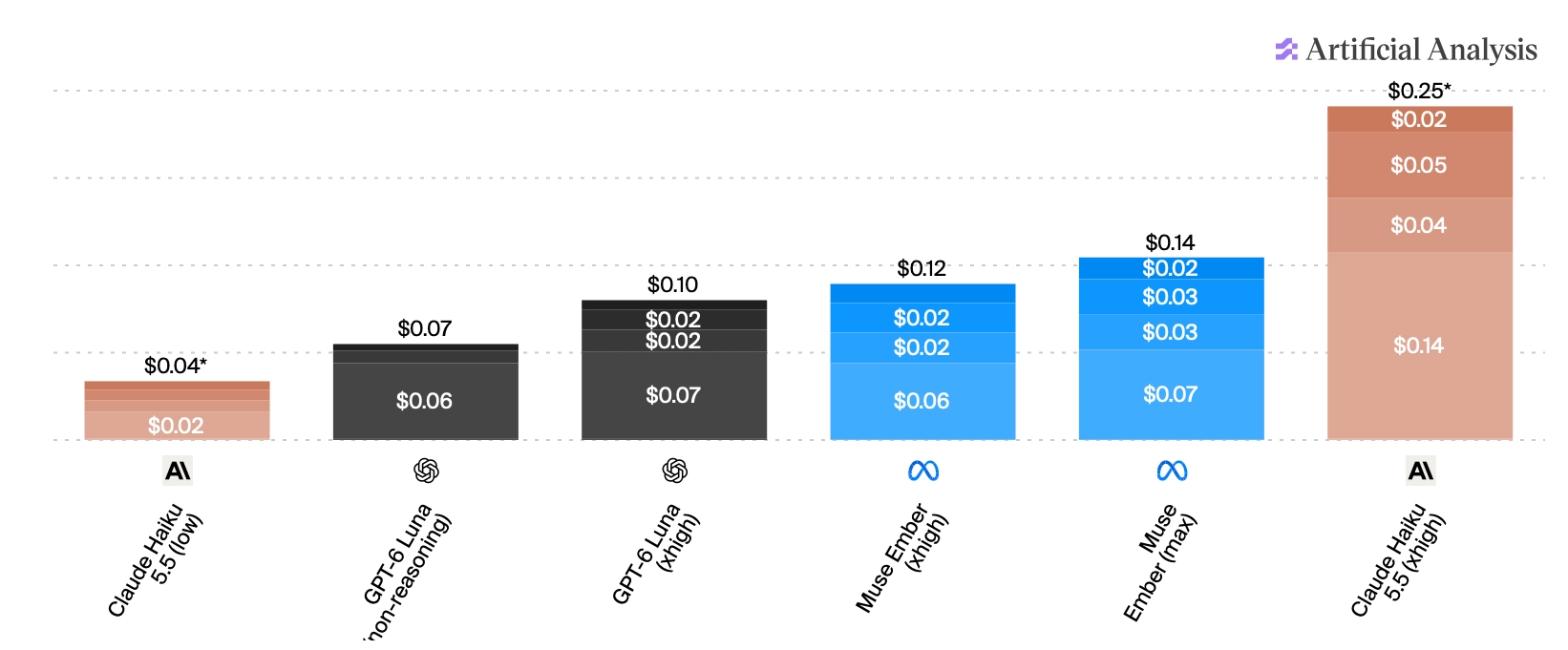
And even more useful than that is their Intelligence Index vs. Cost per Task chart, which shows the following for those three models:
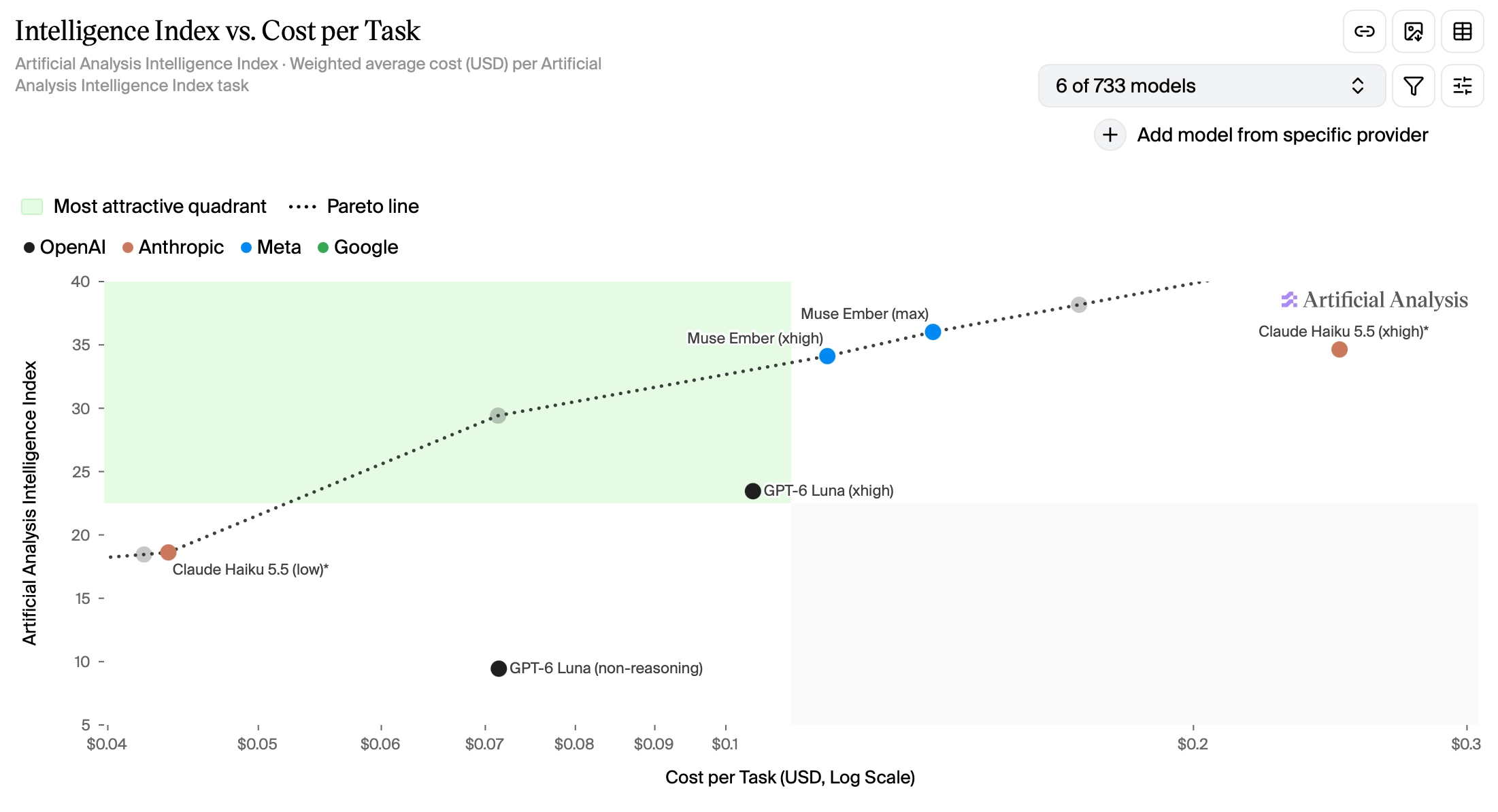
The Muse Ember models sit right on that Pareto line - the line at which you can only improve one dimension by giving up another. Meta call this out in their announcement:
It also sits on the efficiency frontier of the full Artificial Analysis leaderboard: no model scores higher for less per task.
(That grey dot on the Pareto line in the middle of the green area is GPT-6.1 Terra (low) - clearly I should be paying more attention to the Terra family!)
Muse Ember has six reasoning levels - minimal, low, medium, high, xhigh, and max - so I rendered six pelicans riding bicycles. The "high" reasoning level failed to return a full SVG, and the other SVGs were surprising in that the reasoning level didn't cleanly map to the visual quality of the response.
Here's the "max" one, but the others are worth a look too:

The Ember pelicans are comparable in quality to those I got from Muse Wonder, which is 40x the price of Muse Ember.