13 posts tagged “version-control”
2026
Redesigning source control at Anthropic (via) Interesting piece from Anthropic describing why and how they built their own custom alternative to Git, based on the dramatic increase in rate of changes to their code after the past six months.
In May 2026, Anthropic averaged around 2,500 code changes merged per day; as of September, we merged over 30,000 per day.
They included a chart showing those changes. I had Claude modify their chart (code here) to add markers for the public releases of each of their models in 2026:
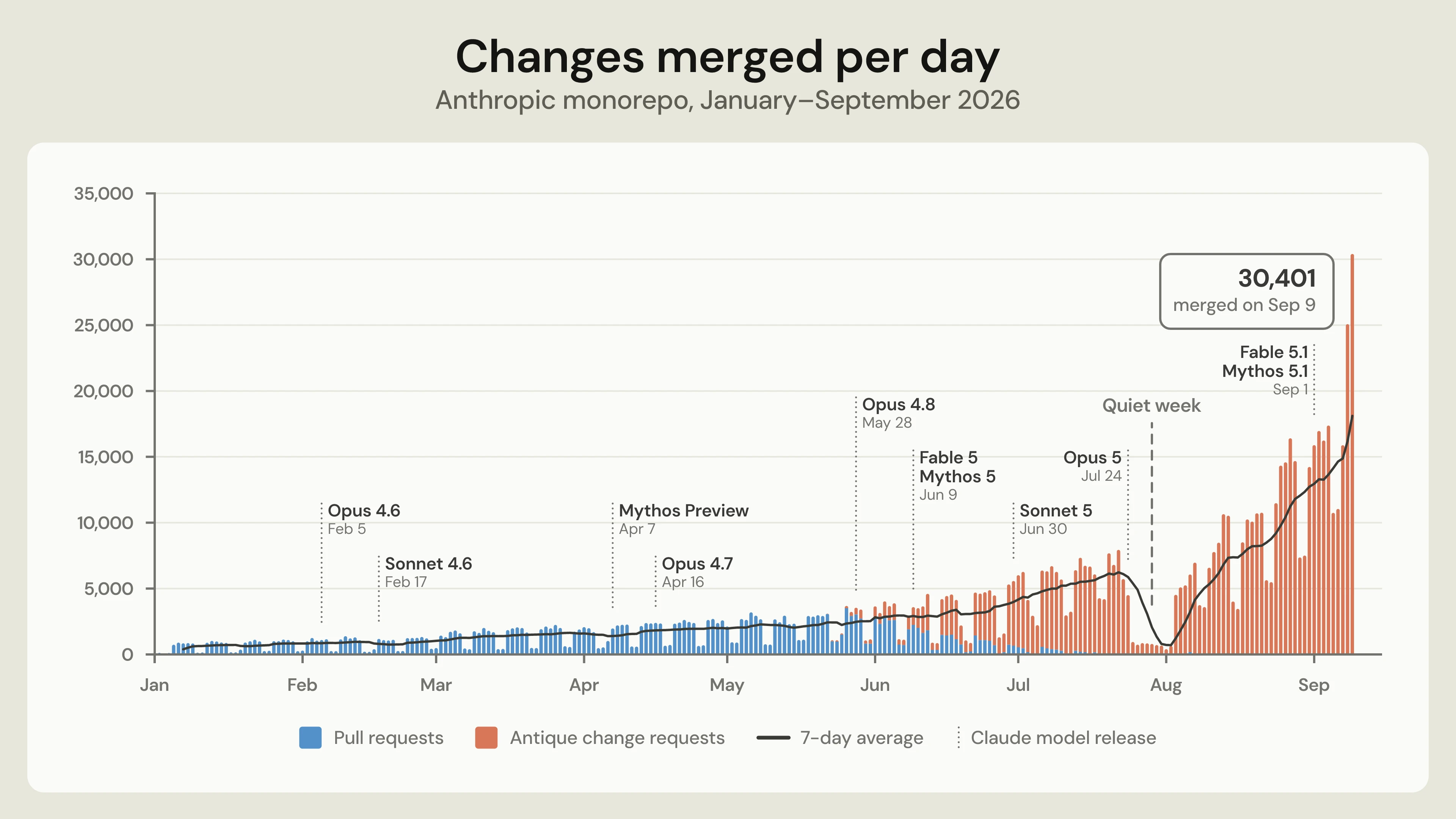
This shows public release dates, not the date when models became available for Anthropic's internal use. My guess is that the introduction of Fable/Mythos class models is a key factor in the increased coding velocity.
"Antique" is their new code review system. The source control system is called Scion, and sounds to me like a reinvention of centralized source control along the lines of Subversion.
(Update: Anthropic credit Google's Piper and Meta's Sapling as "prior art" - it looks like the core concept of "derived data" was heavily inspired by Mononoke, the server component of Sapling.)
They had some pretty extreme requirements:
The history of our main branch alone is almost 100 GB, and a compressed working copy is over 25 GB. We perform on the order of 25 million code checkouts per day for CI, before counting developer environments, agent sandboxes, and research jobs. Fetched naively, that would be over 600 PB of git traffic per day.
The new system was built by a team of seven people, and the migration from Git was completed in five months.
When asked on Hacker News about the lack of offline support, Scion engineer Nick G replied:
Since Claude is by far the heaviest user of Scion and is necessarily online, this just wasn't important to do.
As an aside, I've been trying adversarial review in my own projects recently, where you have a model try and find flaws (I often play Claude and GPT off against each other). This note from the article reflected my own experience with that:
Anthropic also makes extensive use of adversarial review, and, while this is incredibly effective in many ways, it can also be myopic, so skilled engineers needed to steer Claude away from over-engineering parts of the system in response to hypothetical concerns.
I remember hearing a while ago that Dwarf Fortress didn't use version control. That fact has been lodged in my head, because given its inherent complexity I have trouble imagining a codebase that would benefit from version control more. That's art.
I went looking and I'm sad to report that the days without version control appear to have ended. Quoting Tarn Adams over time:
- March 2013: "I don't use version control -- I didn't like the feeling of having the code get committed into a black box thingy with no immediate upside"
- March 2016: "I don’t even use version control. If you don’t know what that is then you’re not gonna yell at me. If you even know what version control is you’re gonna be like, ‘You don’t use version control? You don’t use source control? What is wrong with you? How can you even work? I’m just not cut out for it, in a sense. It’s been 15 years, so the reasons have change over time, but that’s my current understanding of it."
- March 2023: "I've got Discord channels to check and version control stuff to use now, so the process is definitely a little more involved"
That March 2023 quote comes from an interview about the release on Steam which made them millionaires. I'm a tiny bit sad that they gave in before they hit that milestone, but what an impressive run.
2024
This tutorial exists because of a particular quirk of mine: I love to write tutorials about things as I learn them. This is the backstory of TRPL, of which an ancient draft was "Rust for Rubyists." You only get to look at a problem as a beginner once, and so I think writing this stuff down is interesting. It also helps me clarify what I'm learning to myself.
— Steve Klabnik, Steve's Jujutsu Tutorial
Towards universal version control with Patchwork (via) Geoffrey Litt has been working with Ink & Switch exploring UI patterns for applying version control to different kinds of applications, with the goal of developing a set of conceptual primitives that can bring branching and version tracking to interfaces beyond just Git-style version control.
Geoffrey observes that basic version control is already a metaphor in a lot of software—the undo stack in Photoshop or suggestion mode in Google Docs are two examples.
Extending that is a great way to interact with AI tools as well—allowing for editorial bots that can suggest their own changes for you to accept, for example.
2022
Software engineering practices
Gergely Orosz started a Twitter conversation asking about recommended “software engineering practices” for development teams.
[... 1,557 words]2008
Sam Vilain converted Perl's history from Perforce to Git. [..] He spent more than a year building custom tools to transform 21 years of Perl history into the first ever unified repository of every single change to Perl. In addition to changes from Perforce, Sam patched together a comprehensive view of Perl's history incorporating publicly available snapshot releases, changes from historical mailing list archives and patch sets recovered from the hard drives of previous Perl release engineers.
Maybe git is the monads of version control
Tailor. “Tailor is a tool to migrate or replicate changesets between ArX, Bazaar, Bazaar-NG, CVS, Codeville, Darcs, Git, Mercurial, Monotone, Subversion and Tla repositories.”—written in Python.
2007
Subversion WebDAV Autoversioning. Set up a WebDAV share that automatically versions any file saved to it. I had no idea Subversion could do this out of the box.
Unfuddle. Private Subversion repository hosting provider with plans starting at free: now there’s no excuse not to have a svn repository somewhere. Also provides web based repository browsing and a reasonable looking ticket system.
A look back: Bram Cohen vs Linus Torvalds. Makes the case that Git has proved Linus Torvald correct on every point of his infamous debate with Bram Cohen back in 2005.
VCS Migration: The Hare and the Tortoise. Bazaar and Mercurial compared from the point of view of importing 1 million diffs from Mozilla CVS. Bazaar’s import is more robust but will take more than a month to complete.
Hacking Django, how Bazaar. This is a neat trick: use Subversion to track an upstream project, then create Bazaar branches to manage your own development against the trunk.