Tuesday, 13th October 2026
Includes performance optimizations written by Claude Opus 5.5 after I fed it this Python 3.15 profiling report generated by GPT-6 Astra.
If the agent isn't using my diagnostics library, I could introspect and update AGENTS.md, but there's still a delta, and it'll drift. Instead, I write a pre-commit hook that checks the git diff for direct calls to observability modules that bypass my diagnostics module. Boom: fail the commit, inject a prompt telling the agent to use the diagnostics library. All of a sudden it's ten out of ten.
— Geoffrey Huntley, nobody should type code by hand anymore. here's what's left.
I added support to llm-gemini for the new Gemini 4 Argon model, made available today via the Gemini API and for customers of their $100/month subscription plan.
Here are the low, medium and high pelicans. As expected, they are all excellent: Gemini has a track record of producing great SVGs, and are the only lab where I know their staff have invested in SVG specifically (and who have boasted about their pelicans before.)
Here's the "high" illustration, which cost me 17.166 cents:

The pricing is interesting. At launch, Argon is $2/million input and $10/million output - the same price as GPT-6 Sol, half the price of Claude Opus 5.5 and 1/5th the price of Claude Fable 5.1 and GPT-6 Astra.
But on December 1st Argon is set to double in price - so it will be the same price as Opus 5.5.
Prices like this aren't really comparable these days since what really matters is how many tokens a model takes to achieve a goal within an agentic harness.
One useful clue for that comes from Artificial Analysis, who publish the total cost to run their benchmark using each model. Argon is looking very good there - costing $2,407 to run the benchmark, putting it close to GLM-5.3 and significantly cheaper than OpenAI, Anthropic, and Meta's latest models.
When the price doubles it will still be a little cheaper than GPT-6 Astra.
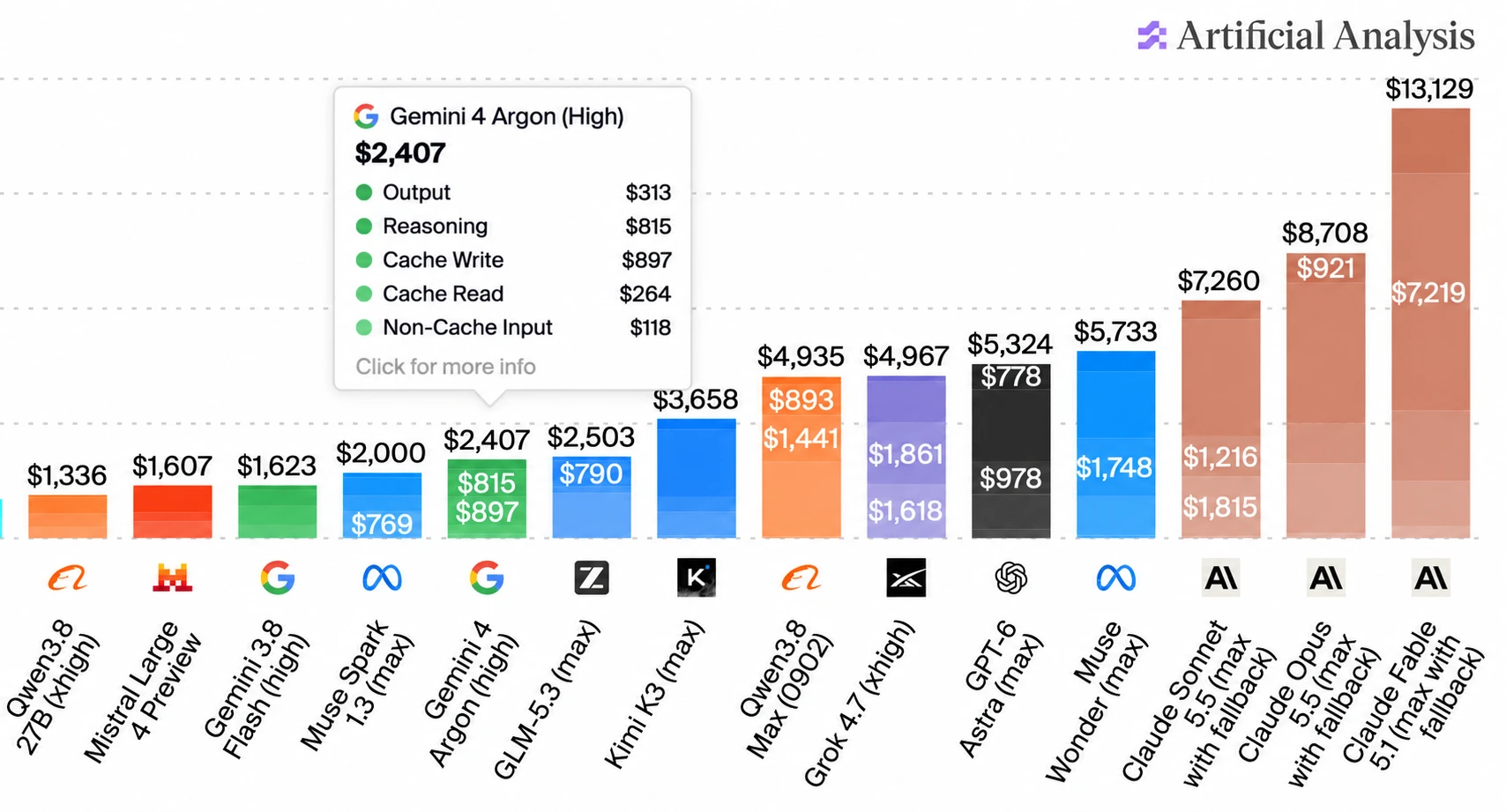
(I used ChatGPT to edit that chart! The data is all correct, I checked - I needed to get that Gemini 4 Argon info box to display without overlapping the other numbers.)
Some bonus examples using Gemini 4 Argon: here's Generate an SVG of an armadillo in fishnet tights jaywalking on Mars, here's a Fabergé egg it created for me using Blender, and DeepMind staffer @fofrAI shared a video of a pelican riding a bike, using fourier epicycles. That's a fun new twist!
Redesigning source control at Anthropic (via) Interesting piece from Anthropic describing why and how they built their own custom alternative to Git, based on the dramatic increase in rate of changes to their code after the past six months.
In May 2026, Anthropic averaged around 2,500 code changes merged per day; as of September, we merged over 30,000 per day.
They included a chart showing those changes. I had Claude modify their chart (code here) to add markers for the public releases of each of their models in 2026:
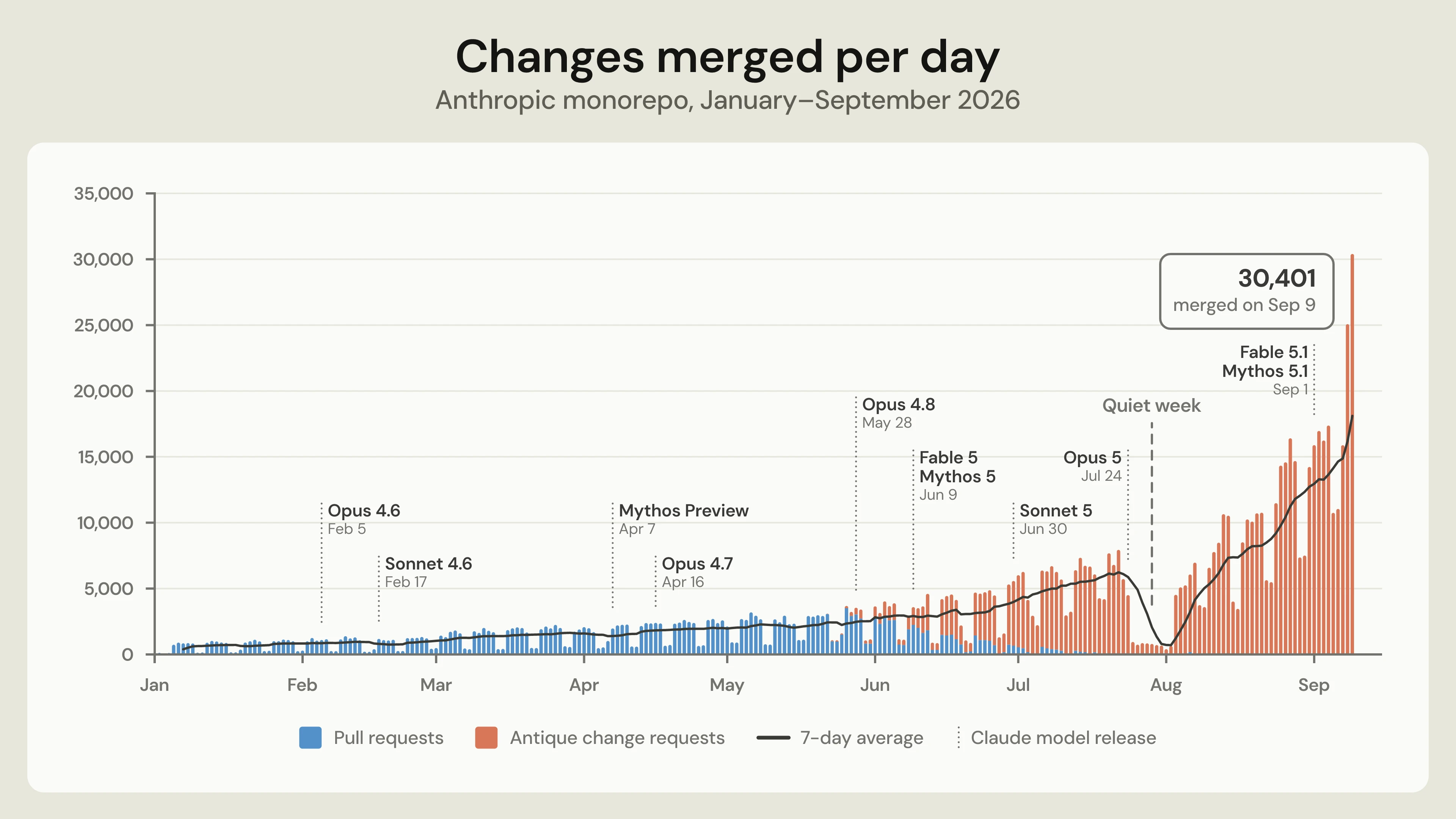
This shows public release dates, not the date when models became available for Anthropic's internal use. My guess is that the introduction of Fable/Mythos class models is a key factor in the increased coding velocity.
"Antique" is their new code review system. The source control system is called Scion, and sounds to me like a reinvention of centralized source control along the lines of Subversion.
(Update: Anthropic credit Google's Piper and Meta's Sapling as "prior art" - it looks like the core concept of "derived data" was heavily inspired by Mononoke, the server component of Sapling.)
They had some pretty extreme requirements:
The history of our main branch alone is almost 100 GB, and a compressed working copy is over 25 GB. We perform on the order of 25 million code checkouts per day for CI, before counting developer environments, agent sandboxes, and research jobs. Fetched naively, that would be over 600 PB of git traffic per day.
The new system was built by a team of seven people, and the migration from Git was completed in five months.
When asked on Hacker News about the lack of offline support, Scion engineer Nick G replied:
Since Claude is by far the heaviest user of Scion and is necessarily online, this just wasn't important to do.
As an aside, I've been trying adversarial review in my own projects recently, where you have a model try and find flaws (I often play Claude and GPT off against each other). This note from the article reflected my own experience with that:
Anthropic also makes extensive use of adversarial review, and, while this is incredibly effective in many ways, it can also be myopic, so skilled engineers needed to steer Claude away from over-engineering parts of the system in response to hypothetical concerns.