Thursday, 15th October 2026
Inspired by Paul Ford and Aboard Foundary's new web app Tiny Little Office, which provides a suite of web app content editors (a Word Processor, Outliner, Presentation Builder, Spreadsheet, Calculator, Drawing Tool, Diagram Maker, Animator, Calendar, and Trip Planner).
Tiny Little Office's signature trick is to store all of the document data in the #fragment section of the URL, so every document created using it becomes a bookmarkable and shareable link.
It also has an llms.txt file telling agents how to construct URLs that will render as documents. Claude used that file to generate this link to a deck that explains how the URL format works:
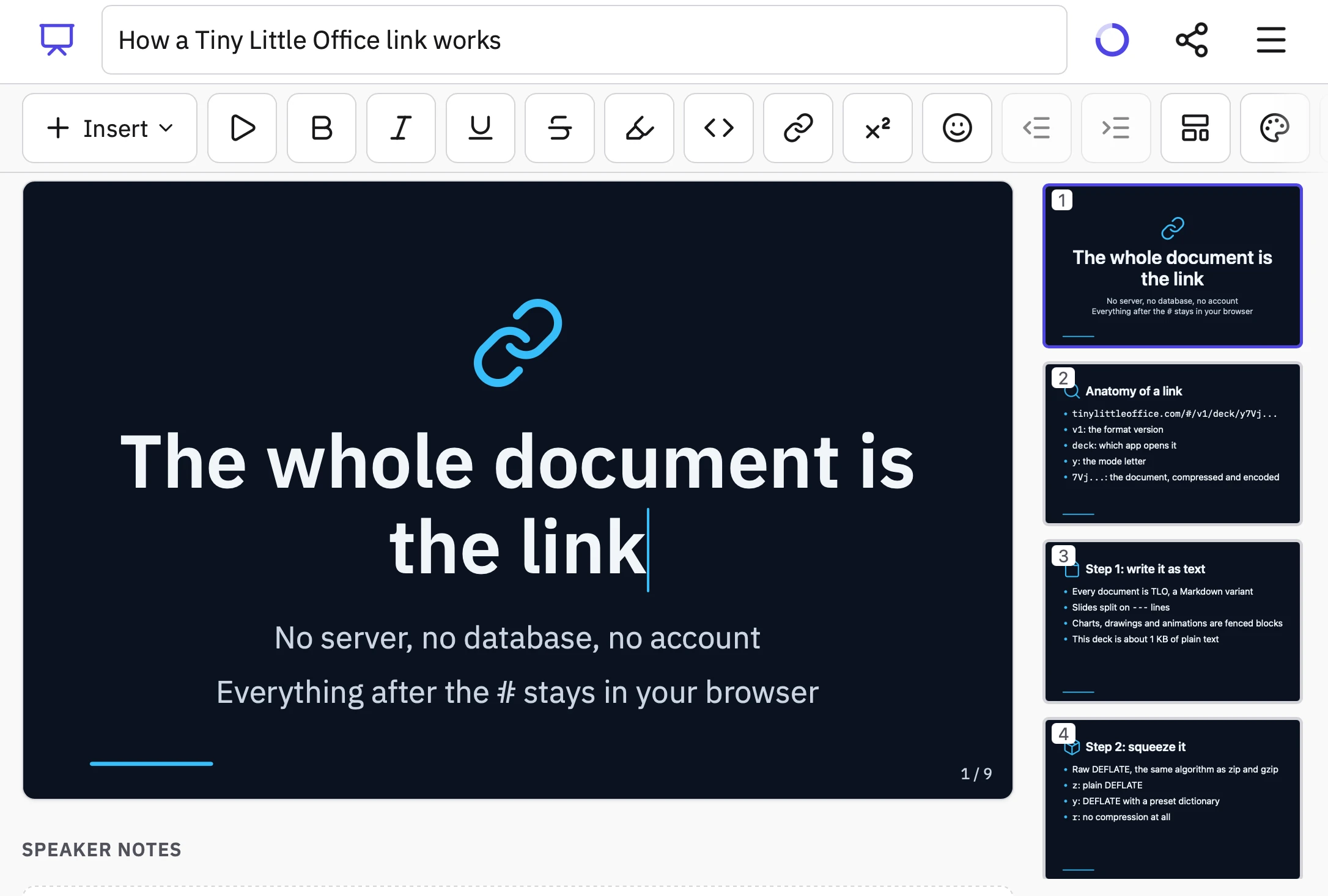
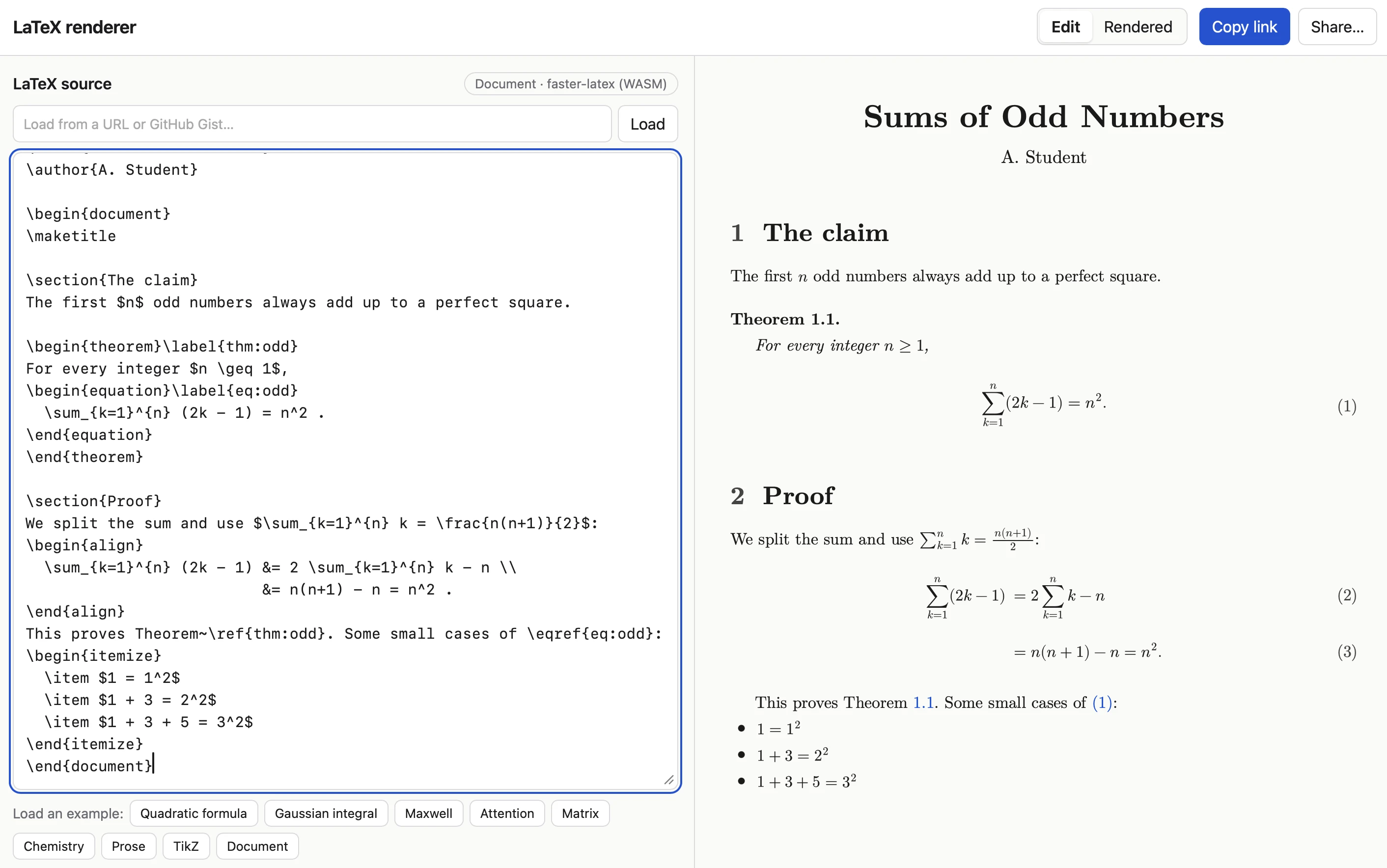
Tiny Little Office inspired me to have Claude Code (Opus 5.5 Extra) build a similar tool that works with LaTeX. Here's the sequence of prompts I used:
I want a tool where you can link to it with a fragment hash #code-here and it treats that code as LaTeX and renders it really effectively. It should also support a prefix which means the latex is compressed with a custom compression dictionary optimized for latex. Use the best available latex render library from a CDN (consider WebAssembly too). If loaded without a fragment hash show an editor you can paste latex into and then toggle to a "rendered" view. That rendered view should be bookmarkable. The #fragment view should let you switch to edit source too.
Since it was working in my tools repo I told it to take inspiration from the <iframe sandbox="..."> mechanism used by my existing SVG in Markdown tool as protection against XSS risks:
Safe from XSS? We could run in an iframe sandbox like we do on the SVG markdown render project
I had it copy the Gist/URL loading feature from that tool as well:
We should have an option to load latex from a URL (or gist) similar to the markdown SVG tool
Here's an example link. The tool uses Pako 2.1.0, MathJax 4.1.3, faster-latex 0.3.1, and DOMPurify 3.4.16.
Anthropic tells investors quarterly revenue up nearly 50% to $16.8bn ahead of IPO. The phrase "told investors" appears four times in this FT article, which reports on Anthropic's day of hosting investors on Wednesday. Lots of details in here from "people with knowledge of the matter".
Key things I learned from the article:
- Q1 revenue (Jan/Feb/Mar) was "about $4.8bn"
- Q2 (Apr/May/Jun) was $11.5bn
- Q3 (Jul/Aug/Sep) was $16.8bn
- In Q3: $1.70 in revenue for every $1 spent on "computing power"
- Adjusted operating margins (excluding stock-based compensation) were 11%
This point about distillation is worth quoting in full (highlight mine):
The start-up has also clamped down on “distillation” — a controversial practice whereby rival AI labs train their models on the outputs of more advanced ones.
When rival companies “distil” their models from Anthropic’s models, that involves heavy usage and spending.
Anthropic told investors on Wednesday distillation accounted for 5 per cent to 7 per cent of revenue and that they had cut it back “materially” in the third quarter of the year, said four people with direct knowledge of the matter.
Napkin maths says that if distillation was 5% of their Q2 revenue (before they cut it back in Q3) then unnamed "other labs" spent over half a billion dollars distilling Anthropic's models in that quarter!
Also notable: Anthropic appear to no longer be leaning on "annualized run-rate revenue" (previously) in these communications to their investors.
Another game experiment - I wanted to see if it was feasible to have a two player game on two separate phones running in static HTML where the networking code uses chirps sent via the microphone. It seems to work!
Build a two player competitive pong like game where two players use their phones close to each other and the game state is sent via audio noises which the web microphone API can interpret - but add graphical and gameplay twists to make it a lot more fun and intertwine than pong
Claude Opus 5.5 Extra in Claude Code.