Tuesday, 6th October 2026
I wanted to see if Claude Opus 5.5 could compose music, so I tried this:
I want you to write some computer game music for me. First design simple text based format for the music and build an artifact that can play it out loud - include some example tracks in that artifact
I am looking for music of the quality of the original secret of Monkey Island
It leaned a lot harder into the Monkey Island theme than I had intended, but the results are surprisingly good.
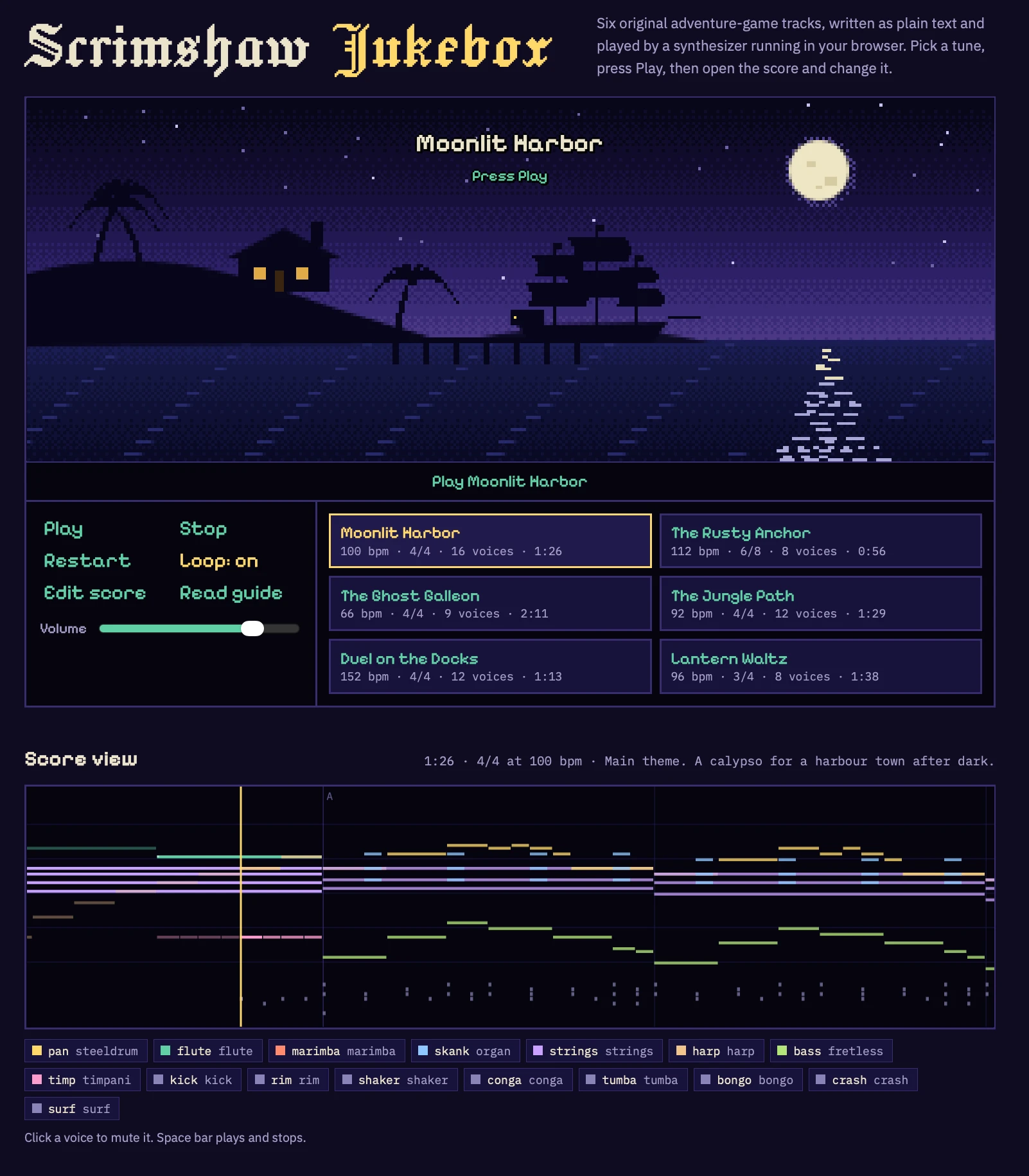
I wonder if the ability to compose competent music is similar to the 3D graphics thing - a new capability for text models that emerged in the past few months?
Would need some careful experiments with other recent and not-so-recent models to confirm if this is new or if they've been able to do this for a while.
A minor fix for compatibility with the latest Datasette alphas. This meant we could upgrade the datasette.io site to Datasette 1.0a41.
I saw Parseable in a Show HN today - it's a new observability platform with both an open source (AGPL) Rust implementation (a single ~180MB binary), an "Enterprise" version with extra features and a cloud hosted option.
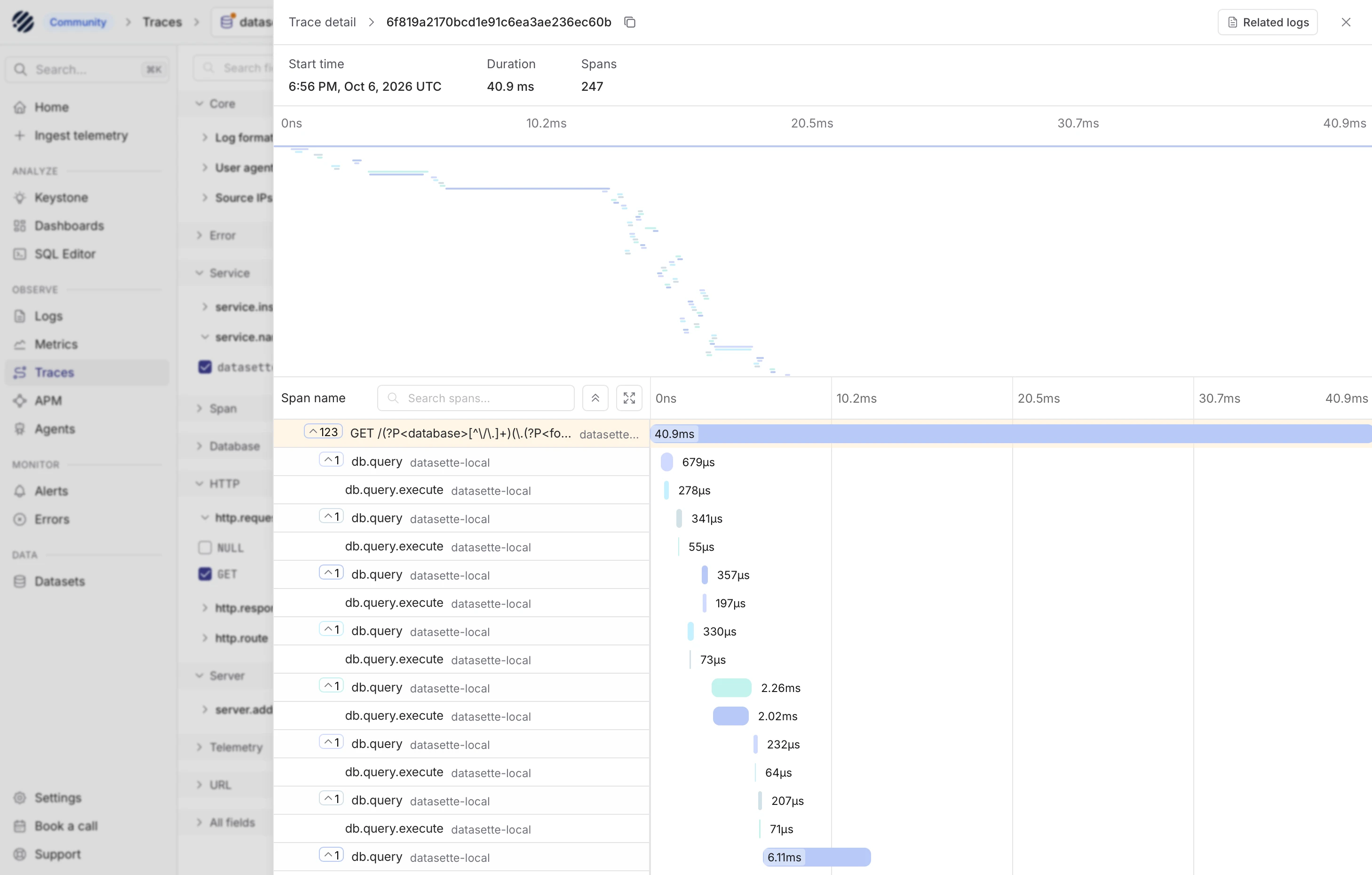
Since Datasette 1.0a41 added OpenTelemetry support (thanks, Alex Garcia), I decided to fire up Codex and have it figure out how to run Parseable and feed it traces from Datasette.
Here's my (human-written) TIL showing the patterns that worked, and here's a screenshot of a Datasette trace displayed within the Parseable localhost web application:
Introducing Mistral Large 4: Le chonk (via) Mistral are back in the game. Today they're releasing a preview of Mistral Large 4, a 1 trillion parameter, 49 billion active parameter model trained on their own cluster of 3,800 NVIDIA Grace Blackwell GPUs.
The preview is available via their API. They promise to release the open weights model at the "end of this month".
The model only supports two reasoning levels - "none" and "high" - via the Mistral API. Here are both pelicans - the "high" one looks better, though surprisingly it only used 2,717 output tokens compared to "none" which used 3,275:

On Artificial Analysis it scores 38, just behind DeepSeek 4.1 Flash, which is a 552B model. It's a huge improvement on last December's Mistral Large 3, which drew this terrible pelican and scored 9 on AA.
It's certainly not a Fable-class model, but it's great to see Mistral put out a model that's back to being maybe about 6 months behind the frontier.
Comment My comment on EmbeddingGemma 2 — Hacker News
I really appreciate that EmbeddingGemma 2 is under the Apache 2.0 license.
For embedding models in particular, I don't think it makes sense to use a closed, proprietary, hosted-only model.
Most applications of embedding models involve calculating thousands or even millions of embedding vectors and storing them for later comparison.
If your model is proprietary, the vendor is likely someday going to decide to stop offering that model. They'll have a better model to replace it, but you still need to pay to re-calculate those millions of stored existing vectors.
(In April 2024 OpenAI offered to "cover the financial cost of users re-embedding content with these new models" - https://openai.com/index/gpt-4-api-general-availability/ - but I don't think that's something we can rely on from every provider.)
Notably, I don't want to host the model myself. I'd much rather pay a provider for a hosted model while knowing that if they ever stop hosting it I can run the open weights version myself - or find another vendor who can do that for me.
Adds support for reasoning models, such as the newly released Mistral Large 4.
OpenAI released their new Jev-style Decisions API, as previously announced at last week's DevDay.
Since I already have an llm-typesafe plugin for talking to Jev, I had GPT-6 Astra read the new OpenAI API documentation and build an llm-openai-decisions plugin inspired by llm-typesafe.
Unlike Jev, the new gpt-6-luna decision model supports image input in addition to text. Both models charge for input it and not for output: OpenAI's is 10 cents per million input tokens, Jev's is 4.2 cents per million.
Otherwise the API shape is very similar to Jev, at least conceptually. Jev supports three question types for yes/no, choices, or scores. OpenAI Decisions supports the same three types.
Install the plugin like this:
llm install llm-openai-decisions
Here's an example query against an image attachment:
llm -m openai-decisions/gpt-6-luna \
  -a https://static.simonwillison.net/static/2025/two-pelicans.jpg \
  -s 'Does this image contain any mammals?'
And example output:
{"type": "predicate", "name": "evaluation", "probability": 0.0}Consult the README for full details of how to run the other types of questions.
Since the Medicare breach, OpenAI has put in place additional monitoring to allow “immediate intervention” by staff to stop training if the company’s models access the internet in ways they’re not supposed to, Mr. Kwon [chief strategy officer at OpenAI] said.
— Victoria Kim, Reporting from the Australian parliament
Comment My comment on Mistral Large 4 — Hacker News
OK well I couldn't resist this one:
Default reasoning levels for each: https://tools.simonwillison.net/markdown-svg-renderer?url=ht...
# 6:20 pm